One engine. Four horizons. Every number traced.
How a Halō twin looks back, sees now, looks ahead and tests what-ifs, and how every answer traces to where it came from.
From what happened to what if.
Past: what happened and why.
Every disruption carries a reason, so a missed target links back to the risk that caused it.
Present: Detect.
Rules flag what's happening now: a fault, a breached limit, a lapsed certificate.
Future: Predict.
Forecasts of what's likely next, each with its confidence and the drivers behind it.
What-if: Explore.
Scenarios play out a change across the operation, show the cascade before and after, and recommend what to do.
Every horizon also takes questions in your own words. Past, present, future and what-if are not limited to the screens we build: ask the twin anything about your operation in plain language, and every answer comes back with its sources.
Four horizons, one event at a time.
Each example follows a single event from what happened to what if.
Past
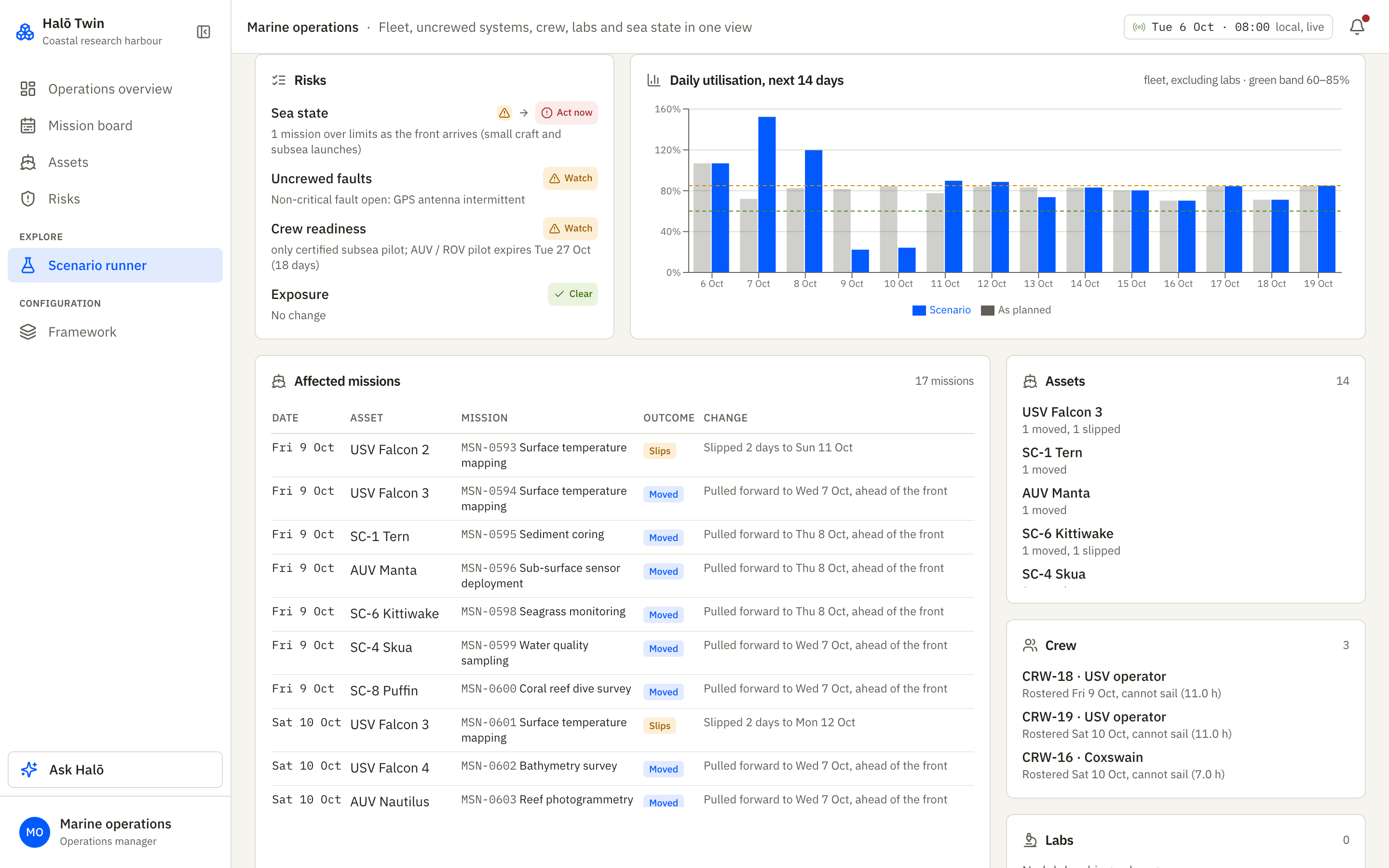
Last season, weather caused most small-craft delays, and labs waited on samples each time.
Present
Today's missions are running to plan, every asset inside its limits.
Future
A front is forecast to close the window for small craft and subsea launches in three days. Go-probability falls, with confidence and the drivers behind it.
What-if
The scenario shows missions slipping, labs waiting and crews idle. It recommends pulling work forward and moving research-vessel work into the bad days.
Past
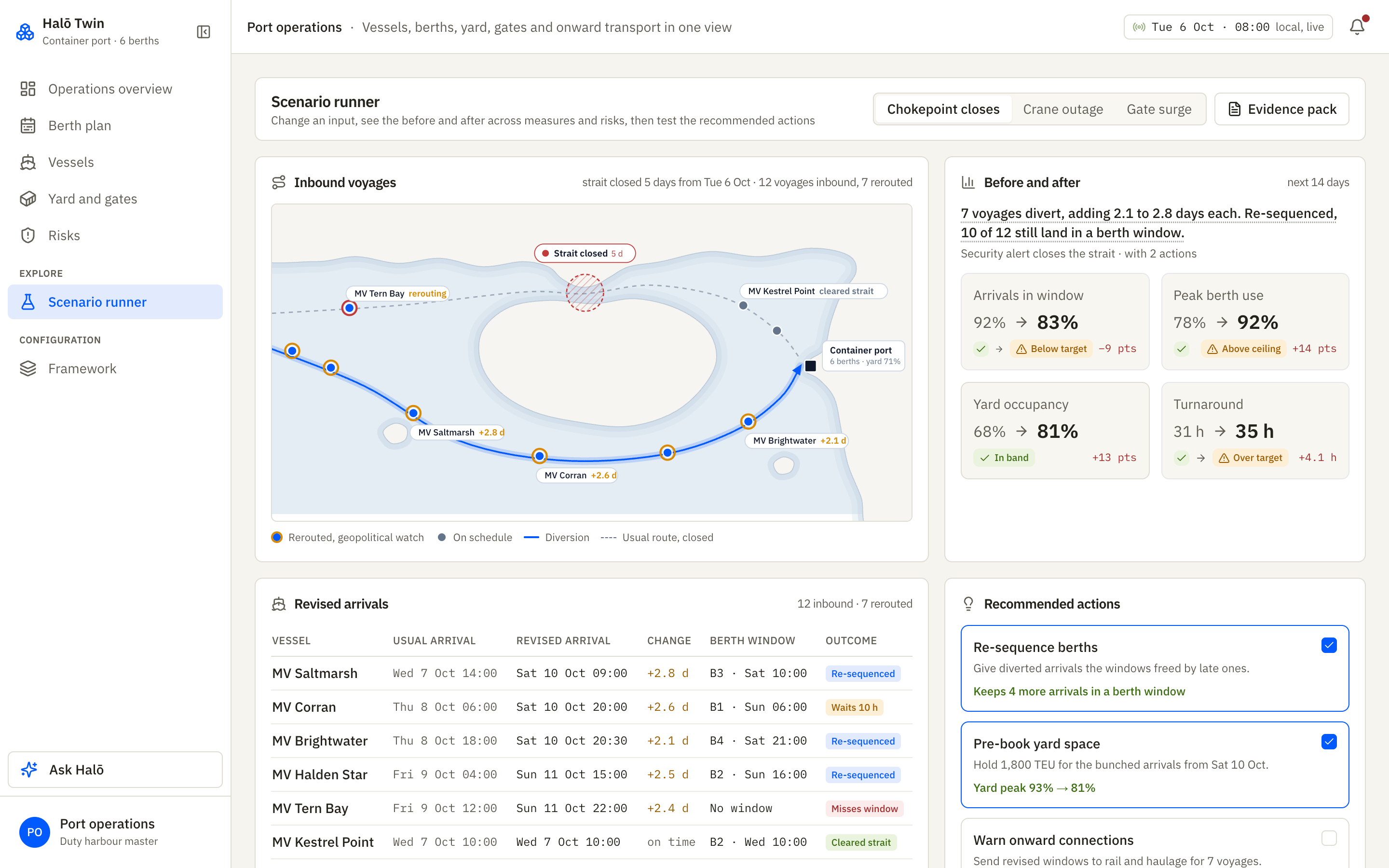
Earlier diversions show how arrivals bunched and berth windows shifted.
Present
Security alerts and vessel tracking show traffic avoiding a strait. Geopolitical risk turns amber for every inbound voyage routed through it.
Future
The twin forecasts which ships divert, the added days and their new arrival windows.
What-if
The scenario shows berths and yard space under pressure. It recommends re-sequencing berths, pre-booking yard space and warning onward connections.
Past
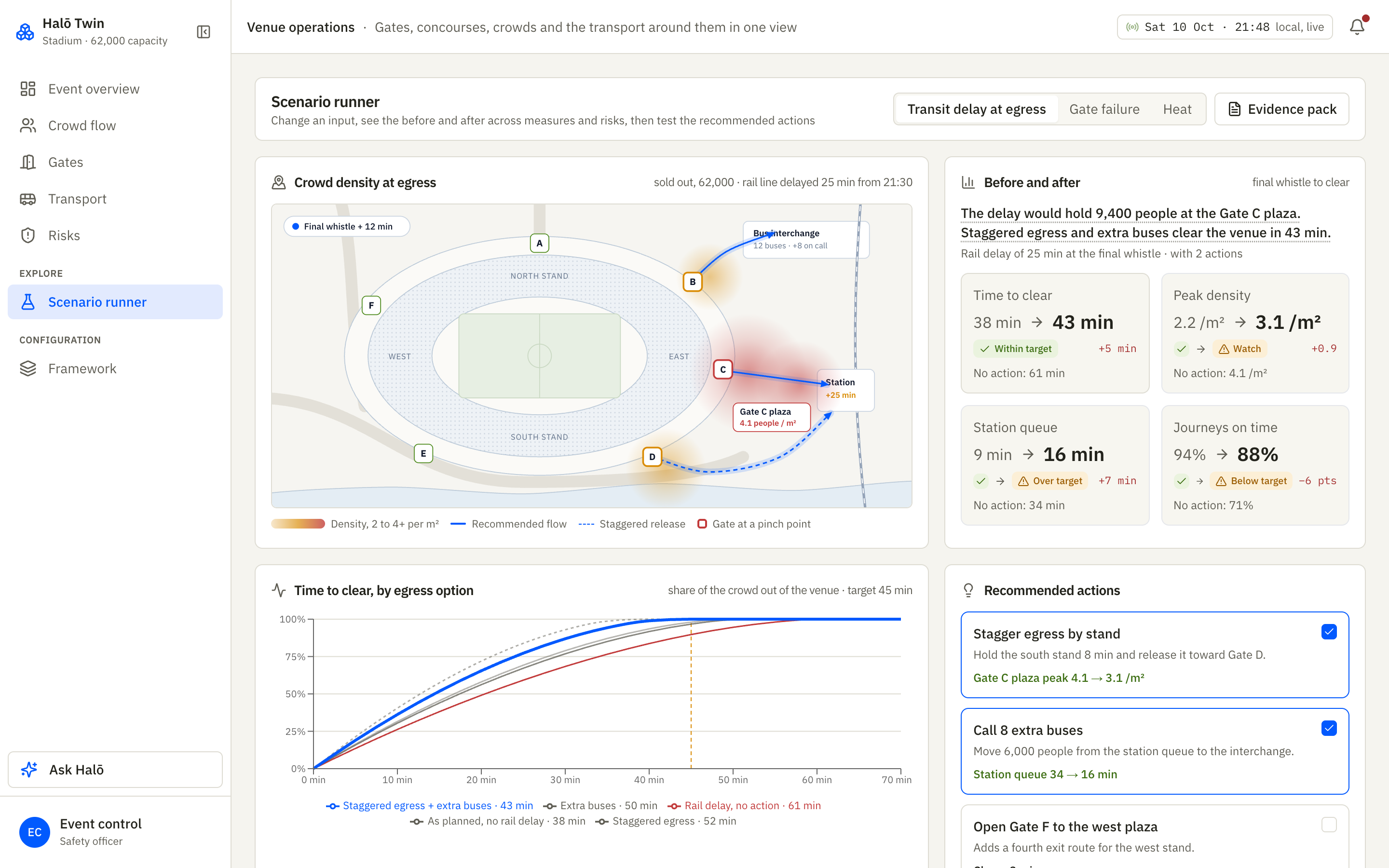
Previous events show how long the venue took to clear and where crowds bunched.
Present
Ticket scans show attendance on plan; a rail line reports delays.
Future
Crowd density at the pinch points and time to clear are forecast to rise, with confidence and drivers.
What-if
The scenario tests staggered egress and extra buses, and recommends the plan that clears the venue fastest.
Real infrastructure, built in layers.
Four layers take the systems you already run to answers you can act on and defend. Security, governance and audit wrap every one.
Signals.
The systems you already run: tracking, telemetry, schedules, ticketing, maintenance, bookings, weather and records.
Engine.
Ingested, cleaned and resolved into one model: assets, people, places and events reconciled across every source.
The twin.
Assets, people and places connected, and measured on Performance and Risk.
Interfaces and evidence.
The four horizons, past, present, future and what-if, with every figure traced to its source.
Measured on what drives your operation.
Every operation is judged on different things. A port lives on throughput and dwell; a venue on experience and safe dispersal; a research fleet on reliability and weather windows. Halō's two frameworks are libraries of standard dimensions. Your twin lights the ones that drive your operation, and the rest are there when priorities change.
The Performance Unit: how well is it running?
Throughput
How much moves through the operation
For exampleFreight units across a quay; passengers through a terminal; missions run per week
Lit for every operation
Choose a preset or any key to see what it measures.
- Dimension
- Measure or risk
- Signals from source
- Target and thresholds
- Status (green, amber, red)
- Source trail
Each measure and risk carries a target and green, amber and red thresholds agreed with you.